

On the 16th December 2011 the JDF organises a Round-Table discussion named ‘Criminal Law Protection of Public Finances’ in cooperation with the Association of the Bulgarian Prosecutors. It will take place in the Conference Hall of the Supreme Court of Cassation at the Sofia Palace of Justice.
The event aims to outline the challenges facing the criminal jurisprudence in its response against forms of economic crime. During the forum researches on the efects of the Criminal Code will be presented, especially focused on financial crime, crimes against branches of the economy, the functioning of the criminal legislation within the EU legal context. Special attention will be paid to:
- normative gaps in the criminal law which have been created as a result from failures of the legislator and restrictive court practice (Sava Petrov, guest-prosecutor in the Supreme Cassation Prosecution, Head of ‘Forensic Science Studies’ department, and Iva Pushkarova, PhD, a JDF criminal law expert);
- criminal law protection of the regimes under the Public Procurement Act (Bojudar Djambazov, Deputy Sofia-City Prosecutor);
– practical problems of Criminal-Code enforcement against conventional property crime related to criminality in the public sector and economy (Radka Stoyanova, a JDF expert in criminal law and procedure);
– criminal law protection of the financial interests in the EU (Hristo Hristev, PhD, a JDF expert on EU law).
The round-table is the third in a chain of initiatives of the Foundation which aim to encourage professional dialogue on crucial legal issues. It is conducted within the framework of the partnership with the professional association of the prosecutors.
With this event the Foundation initiates a large-scale research on the issues of criminal-law protection of the economic and public sectors within an ambition to establish modern criminal-law solution against organised economic crime.
The round table will be attended by representatives of the state prosecution, specialised in the investigation of financial and economic crime, Supreme court judges, representatives of financial institutions, the Executive and the National Assembly, academia and associations of legal professions.
The Justice Development Foundation expresses its gratitude to the Supreme Court of Cassation for the hospitality!
Download the event program here.
Contact person: Ivo Emanuilov
email: office@justicedevelopment.org

On the 30th November 2011 the Commission for Protection against Discrimination held its conclusive National conference on the ‘Equality – A Road to Progress’ Project funded by the European Community Program for employment and social solidarity – PROGRESS (2007-2013) which had been implemented in cooperation with Open Society Institute and the Ministry of Labour and Social Affaires.
 The event allowed the presentation of three analytical modules on law against discrimination which had been developed within the process of project implementation and dedicated respectively to civil and criminal law responses to discirmination. The second group of issues was divided in two and profiled respectively for the professional communities of magistrates (judges, prosecutors and investigators) and investigation police officers.
The three modules satisfy the monographic type of scientific research. They contain a total number of 50 specialized analytical publications together with methodologies for practical interactive trainings, all of which are dedicated to:
- the nature, social roots and social impact of discrimination and the phenomena which are related to it;
 - a comprehensive study of the enforced civil, administrative and criminal national, international and EU law together with the practice, based on it, which had been developed by Bulgarian and foreign courts and international jurisdictions (ECHR and CEU) and committees which are established with international organisations or on international conventional bases. A significant part of the analyses relate to fundamental issues of human rights, interactions of national and supranational legal systems, etc.;
- social and institutional role of the various professions that are charged with prevention and protection against discrimination.
The modules were elaborated by a broad expert team of 34 representatives of the Commission for Protection against Discrimination, court system (Supreme Court of Cassation and Supreme Administrative Court), the Supreme Prosecution Office of Cassation, the National Investigation Office, structures with the Ministry of Interior, the Supreme Council of Lawyers, science and education institutions (Ministry of Interior Academy, National Institute of Justice, Institute for Forensic Psychology with the Ministry of Interior, Center for Education of Lawyers), non-government organisations which are specialised in protection of human rights (Bulgarian Lawyers for human Rights, Bulgarian Helzinki Committee), professional associations (Association of Bulgarian Prosecutors, Association of psycholoysts) and research centers (Justice Development Foundation).
Within the framework of the broad team an authors’ team had been established which had been responsible for the direct development of the modules. It contained 23 narrow specialists – practitioners and researchers – working in the area of legal theory, administration of justice and protection of rights, forensic psychology and psychiatry, criminology and other humanitarian science.
 The JDF participated with a team of 10 experts, six of whom authors (Iva Pushkarova, PhD, Petya Popova, Vladimir Velinov, Zhivko Zhelev, Ivo Emanuilov, Radka Stoyanova) that elaborated as many as 20 publications individually or in co-authorship, one member of the broad team (N. Gunchev) and three scientific editors (Martin Belov, PhD, Hristo Hristev, PhD, and Stoyan Stavru, PhD).
The full text of the modules in Bulgarian is available at Violence and Discrimination Section of the Library.
On the 1st of December 2011 the first edition of the new legal periodical ‘Thesis’, issued by the Association of the Bulgarian Prosecutors, was presented in the Palace of Justice in Sofia. The periodical succeeds the Bulletin which has been issued by the Association for many years and for the coming two years will be published with the financial support of the America for Bulgaria Foundation.
 The concept of the periodical is influenced by a strive that the periodical be developed on professional bases, achieve sustainability and integrate knowledge from different areas of law an humanitarian science with the immediate work of prosecutors. It is issued in implementation of the policy of the prosecutors’ association to open the professional community towards the general public and towards other legal professions and to improve the quality of the prosecutors’ activities as a contribution to the reform in the criminal justice and in the state prosecution.
The periodical is prepared by a small Editorial team where scientific editting of analytical acticles and the administration of the team activities are vested on voluntary bases in two representatives of the Justice Development Foundation – respectively, Iva Pushkarova, PhD, and Petya Popova. That form of cooperation is implemented within the framework of the partnership between the JDF and the professional association of the prosecutors.
 The work of the Editorial team is supported by a broader Public Council which unites distinguished representatives of legal science and administration of criminal justice, as well as spesialists in other areas of humanitarian knowledge (criminology, forensic psychology and psychiatry, sociology) and journalists.
The first edition of the periodical addresses issues of the judiciary reform (related to the electronic system for crime-rate monitoring and to the independence of judiciary). In its sciencntific and prasctical-science part it contains articles dedicated to:
 Legal contracts and criminal liability (Stephan Milev); Specific features of the investigation of cases on property fraud (Peter Raymundov, PhD); Intellectual property contracts and computer crime (Plamen Datsov, judge in the Sofia Apellate Court); Potential conflicts with criminal law relevance between the substitute mother and the accepting parents (Stoyan Stavru, PhD, JDF); Seisure and confiscation of criminally achieved property under the EU law (Todor Kolarov, Head of the Commission for Confiscation of Illegally Achieved Property); Legal regulation of the protection of the financial interests of the EU (Hristo Hristev, PhD, JDF) and Celling and buying of votes as crimes against election rights (Tsvetana Petrova, Ministry of Interior Academy).
The event was attended by representatives of the Union of Jusrists in Bulgaria, National Union of Legal Consultants, the Chamber of Investigators, the Supreme Council of Lawyers, Open Society Institute, Center for the Study of Democracy, the Justice Development Foundation, journalists.
Additional information for the periodical is available in Bulgarian at: http://apb.prb.bg/home/index.php?option=com_content&view=article&id=328%3Aparvi-broi-na-spisanie-qtezaq&catid=99%3Aspisanie-qtezaq&Itemid=130&lang=bg.
On 28th October 2011 the Justice Development Foundation held its first public discussion dedicated to issues which had been studies by its experts. The discussion addressed the ‘Legal Challenges of the Information Society‘ connected to the nature and the regulation of internet relations, the impact of the virtual environment on the contencts and practice of rights and some specific breaches of law which took place in internet.
 Stoyan Stavru outlined issues related to the access to information in internet, the right to manage personally published or personally relevant information, management of internet-identities (profiles, accounts, etc.), virtual social networks and some pathological developments of virtual relations, such as deceitful influence over public opinion by management of fictitious or stolen profiles (astroturfing), unauthorised access to personal data, profile-stealing, cyberbulling, etc. Special attention was paid to the legal interpretation of the injury which is caused in cases of scareware, unrevealed personalization (filtering) of search-results, fishing.
Ivo Emanuilov presented intermediate results of researches related to virtual contracting and electronic documentation. The discussion focused on the freedom to accept in whole the general conditions in negotiationg a customary contract, the form of the acceptance, the nature of the negotiations in chat-communication, case-law on Electronic Document and Electornic Signature Act.
The discussion also touched issues of electronic tracing of convicts and e-justice. The event was attended by the Deputy-Minister of Justice, the President of the National Union of Legal Consultants, Bulgarian Helsinki Committee, ‘Law and Internet’ Foundation, Bulgarian League for Human Rights with the UN, law firms, banks, Regional and City Prosecution offices in Sofia, Sofia University, Varna Free University, etc.
The round-table took place in the Conference Hall of the Supreme Court of Cassation in the Palace of Justice in Sofia.
The Justice Development Foundation expresses its gratitude to the SCC for its hospitality and to all its partners for the support they grant to its studies.
Sorry, this entry is only available in Български.
On 10th-12th October 2011 the Commission for Protection Against Discrimination organised a National seminar: ‘Civil Law Aspects of Prevention and Fight Against Discrimination’ in Varna. The event is apart of a chain of seminars under the project ‘Equality – A Road to Progress’ implemented by the Commission and supported by the Justice Development Foundation by expert activities of its members.
The Foundation was presented by Radka Stoyanova and Iva Pushkarova.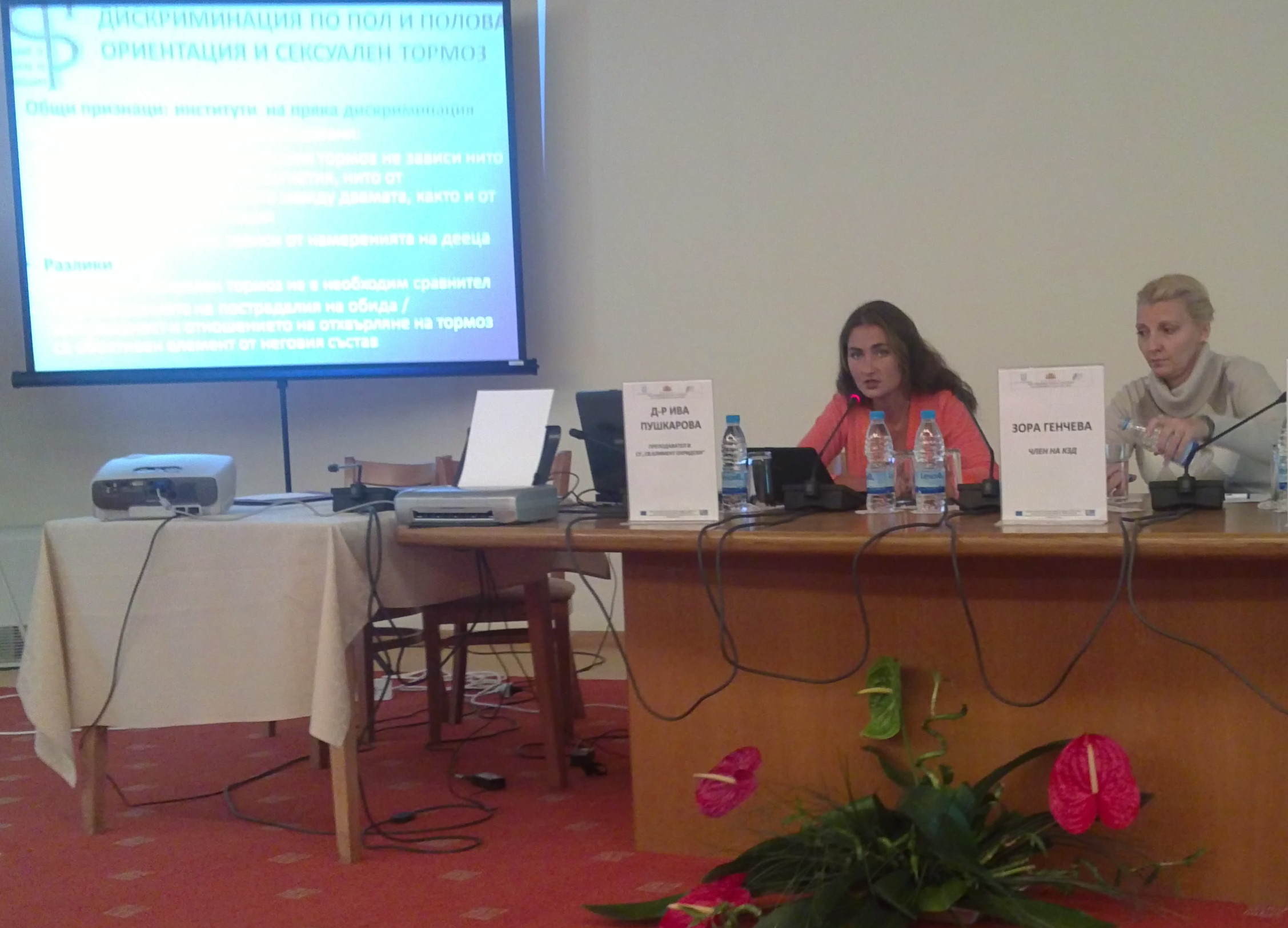
Iva Pushkarova presented part of the results achieved under a research of the anti-discrimination legislation and practice which had been conducted during the summer months within a lecture focused on: ‘Direct and Non-Direct Discrimination. Discrimination Based on Sex and Sexual Orientation and Sexual Harassment. Differentiation and Standards of Evidence in Case Law’.
The complete results of the research on discrimination based on sex and sexual orientation will be presented at a round table, organised by the JDF and scheduled for November 2011 in Sofia. It will be dedicated to issues of rights of secual self-identification, alternative families and legal regimes of non-heterosexual cohabitations.
 On 08-09th October 2011 the Justice Development Foundation carried out its first teambuilding in the spectacular gorge of the Dryanovo Monastery and Dryanovo River.
The event included  extreme challenges such as rock scramble, walking on cord gardens, climbing down into the wild cave Andaka (nearby the ‘Batcho Kiro’ Cave) which had been found by archaeologysts in the beginning of the 20th century and is covered with ancient Bulgarian symbols.
 The team reached the top of the rock, walked through the cord gardens, entered the cave where it needed to conquer the most extreme rout by worming and crawling in long narrow passages, climbing wet rocks, fighting bats, wading through underground rivers and making toys out og clay in order to emerge under the sky again.
After each piece of challenge each member of the team found some kind of a hint-symbol which later helped the team to resolve an ancient scroll written out in rhuna signs.
The teambuilding ended in a warm and cosy place in the middle of the mountain, nearby a chimney and in a heart-felt friendly environment.
 The Justice Development Foundation wishes to express its deepest gratirude to its trainers from te Extreme Sports Club – Dryanovo: Stanislav and Vessela, for their exceptional professionalizm and cordiality!
On 28 the July 2011 the Minister of Justice Margarita popova and the President of the Justice Development Foundation Iva Pushkarova signed a framework partnership agreement. It establishes the principles and conditions under which the parties will cooperate in the administration of the state policies in various spheres of legal drafting, jurisprudence, legal ediucation, legal aid and other issues relevant for the development of justice.
The partners will support each other in conduct of legal, comparative-legal and social researches, trainings, conferences and campaigns, elabotation and implementation of strategies and concepts by exchanging information, expetise, expert consulting and technical assistance.
Active cooperation is envisaged in the fields of modern criminal-law solutions (protection of victims of crime, friendly justice for children, improvement of criminal regimes against economic and organised crime) within the context of EU legal integration in the criminal law sector after the enforcement of the Lisbon treaty, improvement of the legal aid system, analyses and review of crimes appropriate for decriminalization aimed at optimization of the pre-trial procedure, expet support for the drafting of the new Criminal Code. A sphere of intensive cooperation is also the conduct of public discussions on the new Criminal Code and the enforcement of the State Concept for justice for the child.
Between February 2010 and June 2011 the National NGO Network for Civil Society Monitoring over Judiciary conducted a monitoring research of the citizens’ access to justice. It affected 20 courts in 16 court regions in Northern Bulgaria within the framework of the Project ‘Justice Close to People’, funded by ‘America for Bulgaria’ Foundation.
The monitoring team concludes there has been a visible progress in the functioning of the courts related to the subject of the monitoring for the past seven years. There are spheres of functioning of the judicial institutions where crucial for the judiciary reforms laws are being implemented rather formally than substantially. Some practices hide some reluctance for real change which still dominates most magistrates’ attitudes. The attempts to circumvent legal rules by following socially rejected stereotypes reveal that changes in morality and implementation of high standards of professional ethics within the wide community of the magistrates is still about to happen.
Special attention has been paid to issues related to the public conduct of the magistrates in the context of their Ethical Code. The monitoring also focuses on practices of implementation of the law preventing conflicts of interests and the respect for principles of transparency and openness which govern courts’ public information policies.
The research also outlines the role of the jurors. The formal approach of the system related to their involvement in the administration of justice has been criticized.
The monitoring reports on different issues describe the system via the lens of the citizens and constitute a delicate civil society pressure for positive changes in jurisprudence.
With the kind approval of the National NGO Network for Civil Society Monitoring of Judiciary the team of the Justice Development Foundation publishes the package of monitoring reports (all available only in Bulgarian):
Обобщаващ Доклад за напредъка на съда в Северна България, 2010-2011 г.
Граждански наблюдател, септември 2010 г.
Граждански наблюдател, октомври 2010 г.
Граждански наблюдател, януари 2011 г.
Граждански наблюдател, март 2011 г.
Граждански наблюдател, май 2011 г.